
The Question Clients Keep Asking: Can AI Design This?
AI is incredible.
As I’m writing this at the end of 2025, heading into a new year, it feels like AI is everywhere—evolving faster than most of us can keep up with. New tools are launching constantly, images are getting more realistic by the day, and entire industries are questioning what the future of their work looks like.
I won’t pretend I’m not part of it. I use ChatGPT daily. AI has become an incredibly helpful tool in my workflow—for research, organization, early ideation, and communication. It’s powerful, efficient, and genuinely exciting. For interior design, AI can be a great source of inspiration and a way to explore ideas quickly.
But as AI continues to explode, I’ve noticed a growing question from clients:
“Can’t I just use AI to design this?”
It’s a fair question—and one worth answering honestly.
The Part of Design AI Can’t Replace
Interior design isn’t just about what a space looks like. It’s about how it feels. How someone moves through it without thinking. Where they naturally gather, linger, or pass through. It’s about light, proportion, comfort, function, and emotion—often all at once.
Those things are deeply human.
While AI can generate beautiful images, it can’t experience a space. It doesn’t understand how a room feels at different times of day, how energy shifts when people enter, or how a design decision might encourage connection—or create friction.
Why AI Isn’t Enough (Yet)
Interior design requires balancing dozens of variables at the same time—many of which AI simply isn’t sophisticated enough to handle on its own right now.
Things like:
Existing as-built conditions — what’s actually behind the walls and above the ceilings
Building and health codes — which vary by location and must be followed
Budgets — what’s realistic, what’s worth the investment, and where to pull back
Material availability and lead times — especially critical in commercial projects
Durability and appropriateness — what will actually hold up in real life
Lighting — not just how it looks, but how it functions and supports the space
Furniture selection — scale, comfort, circulation, maintenance, and longevity
Client direction and operations — how the space needs to work day in and day out
AI can’t be fed all of this information in a way that results in a thoughtful, buildable, code-compliant design—at least not yet. And even if it could, it would still require someone with experience to know what information matters, and why.
Where AI Falls Short in Practice
Our client recently shared an AI-generated concept for their bar at the 4th Street Market Food Hall in Santa Ana. At first glance, it looked amazing—a lush biophilic design with greenery covering the entire back wall.
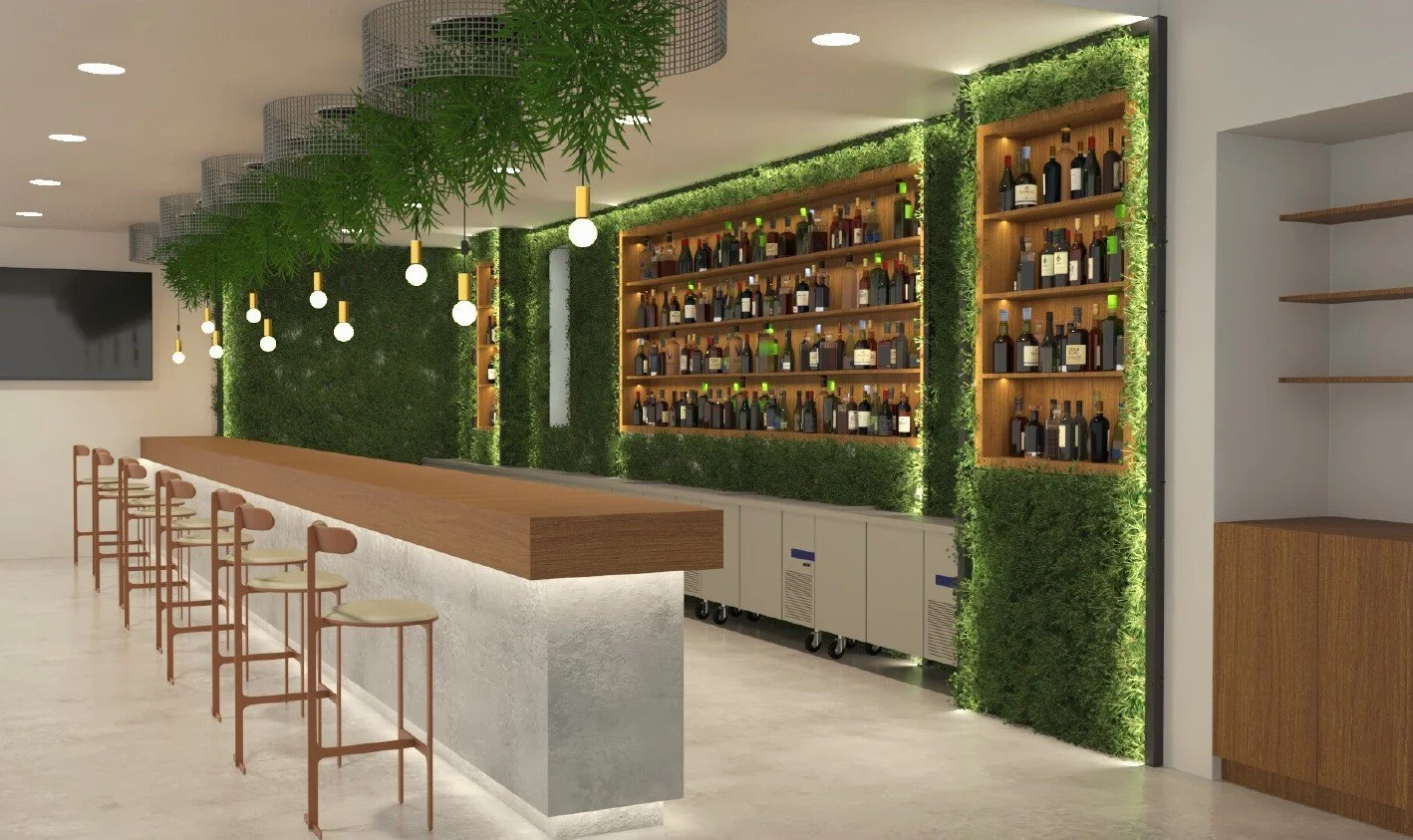
AI Rendering for 4th Street Market - Provided by Client
But in reality:
It would never be approved by the health department
It far exceeded the project budget
It required more maintenance than the client would ever want
And it didn’t fully consider how the bar actually functions
Most importantly, it missed the biggest opportunity—something AI couldn’t “see.”
The interior of the food hall was dark and uninviting, while the adjacent patio had the potential to be incredible but was completely disconnected from the interior—leaving it underused and inactive. The AI concept focused inward, overlooking how powerful it could be to connect inside and outside.
Our solution was to introduce a large awning window at the bar wall—activating the bar from both sides, bringing much-needed natural light into the food hall, and transforming the patio into a true extension of the interior. That decision came from understanding people, movement, light, and experience—not from an image.

Our Rendering for 4th Street Market Bar
The Human Element Still Matters
Maybe someday AI will be able to account for all of these factors. But even then, it will still need someone with knowledge and intuition to guide it.
There will always be something missing without a human involved.
AI can create incredible things, but it isn’t human. It can’t understand how a space affects the way someone feels or why certain places just work. It can’t read between the lines of what a client says—or doesn’t say.
Interior design lives in that space between logic and intuition.
Looking Ahead
I believe AI is here to stay—and that’s a good thing. I’m excited about its potential and continue to use it as part of my process.
But as we head into a new year, one thing feels clear: the best design doesn’t come from choosing between AI and human expertise. It comes from using powerful tools while never losing sight of the human experience at the center of every space.
AI is incredible.
But great design is still—and always will be—human.